
Views: 0 Author: Site Editor Publish Time: 2026-03-11 Origin: Site


A CO2 extinguisher is a portable fire-fighting device that uses compressed carbon dioxide as the extinguishing agent. It is mainly designed for flammable liquid fires and fires involving live electrical equipment.
Unlike water, foam or dry powder units, a co2 extinguisher suppresses fire without leaving residue on protected surfaces, machines or electronic components.
CO2 refers to carbon dioxide stored inside the cylinder under high pressure in a liquefied state. When the extinguisher is activated, the liquid carbon dioxide expands rapidly and is discharged through a horn or nozzle.
Carbon dioxide is non-conductive and chemically stable. Because it does not contaminate equipment or sensitive components, a co2 extinguisher is widely used in locations where cleanliness and operational continuity are important.
Carbon dioxide extinguishes fire mainly by removing oxygen from the flame area and weakening the combustion process. The extinguishing mechanism is based on both smothering and limited cooling.
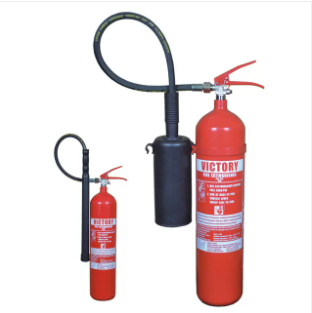
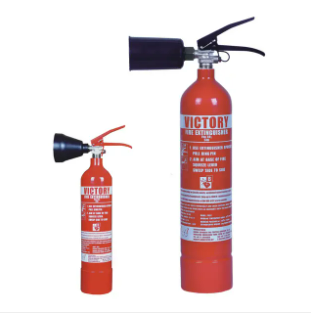
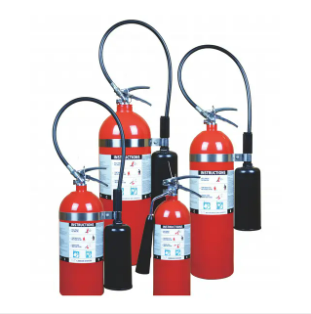
A co2 extinguisher is widely used for Class B fires, which involve flammable liquids. These fires usually burn on the surface of the liquid and can spread quickly across work areas.
Typical applications include fires involving petrol, diesel, lubricating oil, hydraulic oil, paints, alcohols and many industrial solvents used in manufacturing, maintenance and chemical processing.
A co2 extinguisher is especially suitable for fires involving energized electrical equipment. Carbon dioxide does not conduct electricity, allowing operators to attack the fire without increasing the risk of electric shock when power isolation is not immediately possible.
Because the agent is a clean gas, it does not cause secondary damage to electrical cabinets, circuit boards or control systems after discharge.
A co2 extinguisher is commonly installed in electrical control rooms, data centers and server rooms, laboratories and testing facilities, workshops and factories with electrical panels or automation equipment, as well as marine and offshore technical spaces where clean and fast fire suppression is required.
Class B fires involve flammable liquids and combustible fluids. These fires burn on the surface of the fuel rather than deep inside solid material. A co2 extinguisher suppresses these fires by reducing the oxygen concentration around the flame and interrupting the combustion reaction.
This makes the co2 extinguisher particularly effective for small and medium surface fires involving liquid fuels.
CO2 extinguishers can be used on fires involving live electrical equipment such as switchboards, distribution panels, control cabinets, motors and electronic devices.
The non-conductive nature of carbon dioxide allows safe fire-fighting before the electrical supply is fully disconnected.
A co2 extinguisher is not suitable for deep-seated Class A fires involving wood, paper, fabrics or other porous materials, because carbon dioxide cannot penetrate the burning material and re-ignition is likely.
It is also not suitable for Class D combustible metal fires, such as fires involving magnesium or metal powders, which require special extinguishing agents.
In addition, high-temperature cooking oil and grease fires are not appropriate for a co2 extinguisher, as the fire can easily flare up again after discharge.
Dry powder extinguishers are widely used because of their broad fire ratings, but they release a large amount of fine powder during discharge. This powder can enter electrical cabinets, motors and control panels, causing corrosion, mechanical blockage and long-term reliability problems.
A co2 extinguisher, by contrast, leaves no residue at all. This makes it a much better choice for areas containing sensitive electrical equipment, precision instruments and control systems where post-fire clean-up and downtime must be minimized.
Water-based extinguishers are very effective for Class A fires involving solid materials, but they are not suitable for energized electrical equipment. The use of water around live systems can create serious electric shock hazards and may permanently damage equipment.
A co2 extinguisher does not conduct electricity and does not introduce moisture into electrical cabinets, servers or control panels. For this reason, it is commonly selected for electrical rooms, data centers and technical areas.
Foam extinguishers work by forming a blanket over the burning surface and are particularly effective for flammable liquid spills. However, foam leaves liquid residue and requires significant clean-up after use.
A co2 extinguisher suppresses flames by gas flooding and oxygen displacement. It is more suitable for enclosed or semi-enclosed spaces where fast knockdown and clean operation are more important than long-term surface coverage.
One of the main advantages of a co2 extinguisher is that carbon dioxide leaves no powder, liquid or chemical residue after discharge. This prevents secondary contamination of production equipment, electronic components and finished products.
Because carbon dioxide is non-conductive and does not react with electronic materials, a co2 extinguisher can be used safely around energized systems, control panels, computers and communication equipment.
A co2 extinguisher delivers a rapid discharge of gas that quickly reduces the oxygen concentration around the fire. This produces fast flame knockdown, which is particularly valuable in early-stage fires involving liquids or electrical equipment.
In facilities such as data centers, laboratories and automated production lines, restarting operations quickly after an incident is critical. A co2 extinguisher helps reduce clean-up time and allows equipment to return to service faster than residue-based extinguishers.
A co2 extinguisher provides only a limited cooling effect. It mainly suppresses fire by removing oxygen rather than by deeply cooling the burning material. As a result, it is not suitable for deep-seated fires involving solid combustibles.
Because carbon dioxide does not significantly cool the fuel, flammable liquids and hot surfaces may remain above their ignition temperature. If oxygen re-enters the area, the fire can reignite.
The rapid expansion of carbon dioxide during discharge can create a white fog around the nozzle and flame area. This can briefly reduce visibility and make it harder for the operator to see the exact fire source.
Carbon dioxide displaces oxygen. In small or poorly ventilated rooms, the use of a co2 extinguisher can lower oxygen levels to a dangerous point for occupants.
Operators should always keep an escape route behind them, avoid prolonged discharge in confined spaces, and ensure that the area is ventilated immediately after use.
To operate a co2 extinguisher correctly, the standard PASS method is commonly followed.
First, pull the safety pin to unlock the handle.
Second, aim the discharge horn at the base of the fire.
Third, squeeze the operating handle to release the carbon dioxide.
Finally, sweep the discharge from side to side across the flame until the fire is extinguished.
A co2 extinguisher should be operated from an appropriate distance so that the gas cloud can fully cover the fire area. Standing too close may reduce the effective coverage of carbon dioxide, while standing too far away can cause the gas to disperse before reaching the flame.
The discharge should always be directed at the base of the fire rather than the top of the flame.
During discharge, the horn and nozzle of a co2 extinguisher become extremely cold because of rapid gas expansion. Direct contact with bare hands can cause cold burns.
Operators should always hold the insulated handle or grip area and avoid touching the discharge horn itself.
After extinguishing the fire, the area should be monitored carefully for possible re-ignition, especially when flammable liquids or hot surfaces are involved.
The space should be ventilated as soon as possible to restore safe oxygen levels before re-entry.
Smaller capacity models such as 2 kg units are typically used in offices, control rooms and laboratories where early-stage fires are the main concern.
Larger capacities such as 5 kg models are more suitable for workshops, production areas and industrial environments where a higher fire load may be present.
Aluminum cylinders are lighter and easier to carry, making them suitable for locations where portability and ease of handling are important.
Alloy steel cylinders provide higher mechanical strength and are often preferred in industrial or harsh environments where equipment may be exposed to impact or rough handling.
For clean indoor environments such as offices, data centers and laboratories, compact and lightweight co2 extinguishers are normally sufficient.
For factories, workshops and marine technical spaces, more robust models with reinforced cylinders and higher capacities are usually recommended.
When selecting a co2 extinguisher, it is essential to consider the certification requirements of the destination market.
European projects typically require compliance with EN standards and CE marking, while marine applications often require additional approvals for use on board ships and offshore platforms.
CO2 extinguishers are commonly installed in electrical rooms, IT rooms and areas with electrical distribution panels inside office buildings and commercial properties.
In factories and production sites, co2 extinguishers are typically placed near machinery, electrical cabinets, test benches and control stations where electrical or flammable liquid risks exist.
Substations, control centers and electrical distribution facilities often rely on co2 extinguishers for initial response to equipment fires.
CO2 extinguishers are widely used in engine rooms, switch rooms and technical compartments on ships and offshore platforms because of their clean and fast suppression characteristics.
In the European market, co2 extinguishers are normally manufactured and tested in accordance with EN standards and must carry CE conformity marking. These requirements ensure consistent performance, safety and product traceability.
For marine and offshore use, additional approvals are usually required to demonstrate that the extinguisher is suitable for shipboard conditions such as vibration, humidity and corrosion.
Manufacturers typically operate under certified quality management systems to ensure consistent production, inspection and traceability of critical components such as valves, cylinders and safety devices.
Regular visual inspections should be carried out to check the condition of the cylinder, hose, horn, safety pin and tamper seal. The extinguisher should be easily accessible and clearly visible.
Although a co2 extinguisher does not use a pressure gauge in the same way as stored-pressure units, its weight and sealing condition should be checked to ensure that no carbon dioxide has leaked from the cylinder.
Periodic inspection and testing intervals should follow local regulations and applicable standards. After any discharge, the extinguisher must be refilled and inspected by qualified service personnel before being returned to service.
Yes. A co2 extinguisher is suitable for use on energized electrical equipment because carbon dioxide is non-conductive and does not damage electronic components.
A co2 extinguisher can be used indoors, but caution is required in small or poorly ventilated spaces. After discharge, the area should be ventilated immediately to restore safe oxygen levels.
No. Carbon dioxide is a clean gaseous agent and does not leave powder, foam or liquid residue after use.
The discharge time depends on the size of the extinguisher. Small portable models usually discharge within several seconds, while larger units provide a slightly longer discharge period.
A co2 extinguisher is mainly used for fires involving flammable liquids and energized electrical equipment. Its clean, non-conductive and fast-acting characteristics make it particularly suitable for electrical rooms, data centers, laboratories, workshops and marine technical spaces.
When selected correctly and used safely, a co2 extinguisher provides effective early-stage fire suppression while minimizing secondary damage to valuable equipment and critical facilities.
As a professional fire-fighting equipment manufacturer, Victory supplies certified and reliable CO2 extinguishers for commercial, industrial and marine applications, helping customers select the right solution for real working environments and long-term fire safety protection.


