
Views: 0 Author: Site Editor Publish Time: 2026-06-15 Origin: Site


The global phase-out of PFAS ("forever chemicals") has forced industrial facility managers to urgently rethink their first-line fire defense. Traditional Aqueous Film-Forming Foam (AFFF) is rapidly becoming a regulatory and insurance liability. For high-risk environments like warehouses and fuel storage tank farms, transitioning to a fluorine-free foam fire extinguisher is no longer optional—it is a critical compliance and operational mandate. You simply cannot ignore the shifting legal landscape. This guide breaks down the performance realities, compliance drivers, and evaluation criteria for deploying F3 extinguishers in high-hazard industrial zones. You will learn how modern suppression agents perform, why hardware compatibility matters, and what to watch out for during a facility-wide rollout.
Regulatory Urgency: Environmental agencies and commercial insurers are actively penalizing the continued use of PFAS-containing AFFF.
Proven Efficacy: Modern F3 extinguishers meet stringent Class A and Class B fire ratings, effectively suppressing hydrocarbon and polar solvent fires without fluorinated surfactants.
Application Realities: Replacing AFFF with F3 requires understanding changes in foam viscosity, application techniques, and hardware compatibility.
Liability Reduction: Proactive adoption of F3 limits exposure to environmental cleanup costs and aligns with evolving corporate ESG targets.
Fluorinated foams contain per- and polyfluoroalkyl substances (PFAS). We commonly call these "forever chemicals" because they resist natural degradation. They accumulate in the environment and contaminate local groundwater supplies. Over the past decade, health organizations have linked PFAS exposure to severe human health risks. As a result, global environmental agencies are implementing strict bans on AFFF. Regulatory bodies now demand urgent action from industrial operators. Continuing to use legacy foams invites intense regulatory scrutiny.
Commercial insurers have also changed their risk models. They view legacy AFFF as a massive financial liability. Many insurance providers now raise premium costs for facilities retaining fluorinated foams. Furthermore, insurers frequently rewrite policies to include explicit coverage exclusions for PFAS contamination. If an AFFF discharge occurs, your insurance policy might not cover the resulting environmental damage. This leaves companies entirely responsible for astronomical cleanup bills.
Facility managers must weigh the cost of inaction against the initial transition investment. Upgrading to modern suppression equipment requires capital. However, this upfront expenditure pales in comparison to potential environmental remediation fines. A single accidental AFFF discharge can trigger years of legal battles and soil decontamination efforts. Proactive organizations eliminate this risk entirely. They replace outdated equipment before regulators or insurers force their hand. Taking action early protects both the local environment and the corporate balance sheet.
Warehouses typically contain highly complex fuel loads. Facility managers deal simultaneously with combustible packaging materials (Class A hazards) and hazardous stored liquids (Class B hazards). Forklifts use hydraulic lubricants. Shelves hold enormous quantities of cardboard and plastic wrap. A localized fire can easily involve both hazard classes. F3 technology provides essential dual-threat capability. It handles mixed-hazard environments safely and effectively. You do not need multiple agent types for initial spill containment.
Traditional AFFF relied on a very thin, invisible chemical film to suppress vapors. F3 operates entirely differently. It achieves rapid suppression without using any fluorinated film. Instead, F3 creates a thick, highly stable bubble blanket. This physical barrier completely isolates the fuel surface from ambient oxygen. The dense foam also contains a massive volume of water. The foam blanket drops the temperature of deep-seated warehouse fires rapidly. This dual action of cooling and smothering stops fire spread in its tracks.
Post-fire cleanup poses a major operational challenge in logistics settings. Facility downtime destroys supply chain schedules. Legacy AFFF required specialized hazardous waste disposal protocols. Decontaminating a warehouse floor after an AFFF discharge took days. F3 agents offer a massive operational advantage here. They biodegrade much faster and lack toxic PFAS compounds. Cleaning up F3 residue requires significantly less regulatory oversight. Maintenance crews can wash down the affected area and resume normal operations much sooner. This rapid recovery capability makes F3 ideal for high-density logistics hubs.
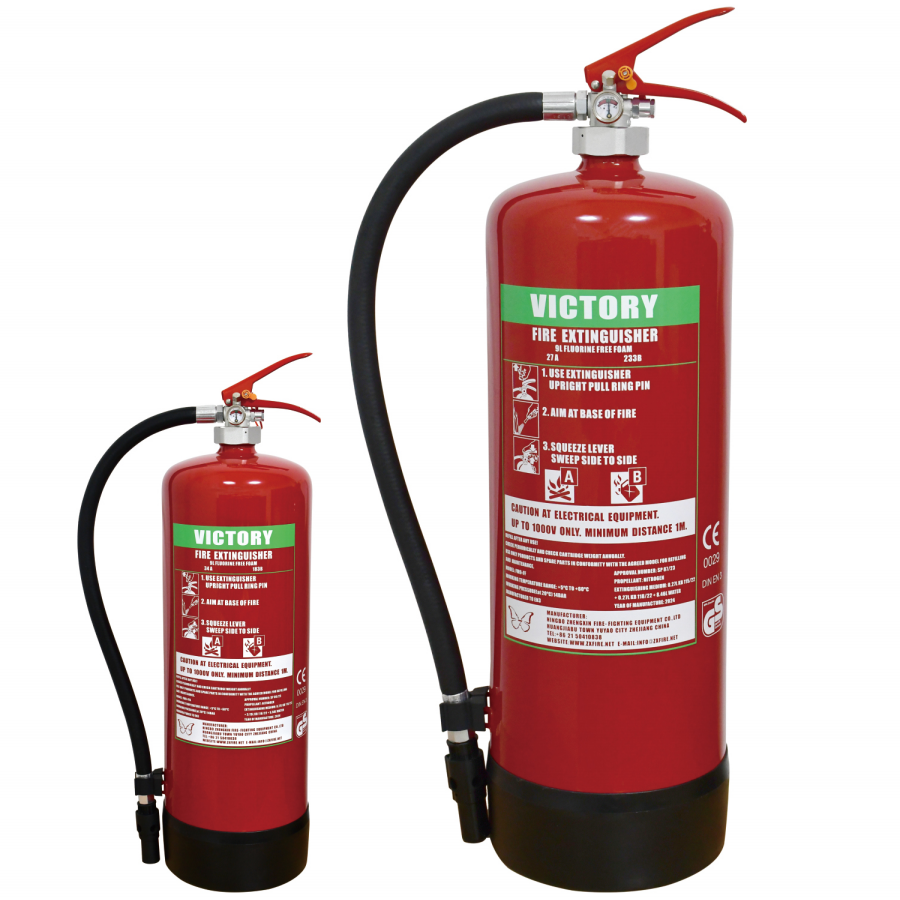
Fuel storage areas present extreme suppression challenges. A spill fire in a tank farm releases intense radiant heat and highly explosive vapors. Emergency responders must achieve immediate vapor suppression. If they fail, the hydrocarbon fuels will reignite instantly. Modern F3 formulations tackle this challenge effectively. They generate a dense, durable foam blanket. This physical barrier completely seals off the fuel surface. It traps the flammable vapors underneath, preventing them from mixing with oxygen.
In a tank farm environment, rapid response prevents catastrophic escalation. Massive fixed foam systems often take time to activate fully. During this critical window, portable units serve as the first line of defense. Staff use wheeled units to contain expanding spill fires. A handheld Extinguisher provides immediate knockdown power for smaller valve leaks or pump failures. By deploying these portable F3 units, operators can isolate the threat before it compromises the entire storage facility.
Performance metrics matter deeply when fighting fuel fires. Two critical factors are drain time and heat resistance. Drain time refers to how quickly the water separates from the foam bubble structure. High-quality F3 agents boast excellent drain times. They hold their water content for extended periods. This characteristic helps the foam maintain its structural integrity against intense radiant heat. Because F3 lacks a self-healing chemical film, the foam blanket must remain thick and robust to prevent burnback. Modern agents achieve this mechanical durability reliably.
Facility managers must verify independent testing standards before purchasing new equipment. Never rely solely on manufacturer marketing claims. Look for established certifications like UL, EN3, or specific MIL-SPEC transition approvals. These independent testing bodies rigorously evaluate foam performance. You must also ensure the unit carries the correct rating for your specific hazard class. An uncertified agent poses a massive safety risk during an emergency.
You cannot ignore the physical properties of the new foam agents. F3 agents are generally much more viscous than legacy AFFF. They feel thicker and flow differently under pressure. This increased viscosity directly impacts equipment functionality. You must evaluate if your existing hardware can handle the new agent. Older valves might restrict the flow of thicker foams. Internal siphon tubes might clog over time. In many scenarios, entirely new units are required to ensure reliable operation.
Aeration is a mandatory requirement for F3 applications. Traditional AFFF could sometimes suppress fires using standard, non-aspirated nozzles. The chemical film did the heavy lifting. F3 does not have this luxury. It requires specialized aspirated nozzles to mix ambient air directly into the fluid stream. This aeration process generates the thick mechanical foam blanket necessary for Class B fires.
The following table illustrates the operational differences between nozzle types:
Feature | Non-Aspirated Nozzle (Legacy) | Aspirated Nozzle (Required for F3) |
|---|---|---|
Air Mixing | Minimal ambient air introduced. | Actively draws air into the agent stream. |
Foam Expansion | Low expansion ratio. Thin watery layer. | High expansion ratio. Thick, voluminous foam. |
Blanket Durability | Relies on chemical film for sealing. | Relies on thick bubble structure to seal vapors. |
F3 Compatibility | Highly dangerous. Blanket will fail. | Mandatory. Ensures proper mechanical smothering. |
Many organizations initially attempt to save money by reusing old equipment. They quickly discover the harsh realities of PFAS decontamination. Triple-rinsing old AFFF cylinders is a complex and costly process. Furthermore, it carries severe residual contamination risks. PFAS compounds adhere aggressively to metal surfaces and rubber seals. Even after extensive cleaning, trace amounts can leech into the new F3 agent. This trace contamination ruins your compliance efforts. Replacing the entire unit is frequently the safer, more compliant route. New factory-filled units guarantee zero cross-contamination.
Switching suppression agents fundamentally changes how your staff must fight fires. Legacy AFFF allowed operators to use forceful, direct application. They could shoot the foam directly into the center of the burning fuel. The chemical film would quickly spread across the surface. F3 agents fail under these aggressive tactics. If you plunge F3 directly into the fuel, it becomes submerged and loses its effectiveness. F3 requires a specific "gentle application" technique.
Facility safety officers must update staff training to include these mandatory steps:
Identify a vertical target: Locate a wall, tank shell, or solid object behind the fire.
Bank the foam: Direct the foam stream at the vertical surface, not the fuel.
Allow it to flow: Let the thick foam run down the surface and gently roll over the burning liquid.
Build the blanket: Continuously apply the agent until a thick, unbroken layer forms across the entire hazard area.
Long-term readiness requires dedicated maintenance schedules. Facility managers must establish strict inspection intervals. Modern F3 agents generally boast excellent chemical stability. However, they lack the toxic preservatives found in legacy foams. You must closely monitor storage temperatures. Extreme heat or freezing conditions can compromise the agent's viscosity and performance. Always verify manufacturer specifications regarding shelf life. Ensure your maintenance teams routinely check nozzle aspiration holes for debris or blockages.
Summary: The transition away from legacy AFFF is an inevitable regulatory reality. It also represents a vital modernization of global facility safety standards.
Final Verdict: F3 technology demands updated training and careful hardware evaluation. However, its efficacy in high-density warehouses and fuel storage farms is proven. It is essential for comprehensive risk mitigation.
Next Action: Facility managers should immediately conduct a comprehensive fire risk audit of their current AFFF inventory. Consult directly with certified fire protection specialists to develop a safe, compliant phase-out strategy.
A: Generally no. Due to strict PFAS decontamination standards and differing viscosity requirements, retrofitting is highly risky. Older nozzles often fail to properly aspirate thicker F3 agents. Purchasing factory-filled F3 units is the prevailing industry recommendation.
A: Yes, but you must specify an Alcohol-Resistant (AR-F3) formulation. Standard F3 agents degrade rapidly when exposed to polar solvents like ethanol or acetone. Always match the agent to your exact hazard class.
A: Modern F3 agents typically offer a comparable shelf life. Concentrates often last 10 to 15 years under proper conditions. Premixed portable units vary by manufacturer. Always verify specific manufacturer guidelines to ensure long-term readiness.
A: Yes. Personnel must undergo retraining. Operators must learn the "gentle application" method. F3 relies entirely on building a mechanical blanket. Forceful application submerges the foam and destroys its fire-stopping capabilities.


