
Views: 0 Author: Site Editor Publish Time: 2026-07-10 Origin: Site


Commercial kitchens operate under extreme heat and high pressure every single day. Cooking oil fires ignite rapidly and burn intensely. These Class K hazards demand highly specialized suppression tools. Relying on incorrect equipment causes severe safety hazards. It also triggers immediate code violations and forces costly operational downtime. Facility managers face mounting pressure to protect their assets from catastrophic fire damage. You cannot afford to guess when outfitting your cooking line.
This guide outlines the exact evaluation criteria you need to make an informed decision. We break down the precise sizing logic and strict compliance mandates required for your specific facility. You will learn how to choose the correct unit for your environment. We also explain how to satisfy local fire marshals, maintain your insurance coverage, and ultimately protect your commercial asset from devastating losses.
Saponification is mandatory: Only wet chemical agents can effectively neutralize high-temperature grease fires by converting the oil into a non-combustible soap.
Compliance is non-negotiable: Purchases must align with NFPA 10 (or local equivalent) standards for Class K hazards to maintain insurance validity and pass inspections.
Environment dictates specs: Extinguisher sizing (e.g., 6L vs. 9L) and additive requirements (e.g., anti-freeze properties) must match the specific footprint and climate of your cooking facility.
Placement matters: Purchasing is only half the compliance equation; correct mounting distance from the hazard zone is legally enforced.
Commercial cooking environments present unique fire risks. Deep-fat fryers hold gallons of oil heated to temperatures routinely exceeding 350 degrees Fahrenheit. If a thermostat fails, cooking oil can reach its auto-ignition point. The resulting fire burns much hotter than standard flammable liquids. You cannot fight this hazard with traditional methods. Standard Class A, B, or C extinguishers completely fail here. In fact, they often make the situation worse.
Using a water-based extinguisher on a grease fire causes a catastrophic reaction. Water sinks below the burning oil and vaporizes instantly. It expands massively in volume, ejecting flaming grease across the kitchen. Dry powder extinguishers also fail. They knock down the initial flames but cannot cool the incredibly hot oil underneath. Once the powder crust breaks, the superheated oil vapors contact oxygen and re-ignite instantly. CO2 extinguishers simply blast high-pressure gas, which easily blows burning grease onto walls and nearby equipment.
To combat this, you need a highly specific chemical reaction. A wet chemical fire extinguisher provides exactly this. These units discharge a specialized fine mist. The mist contains alkaline mixtures like potassium acetate, potassium citrate, or potassium carbonate. When these chemicals contact superheated animal fats and vegetable oils, a rapid reaction occurs.
This reaction is called saponification. Saponification chemically alters the fat, converting it into a thick, soapy foam blanket. This foam layer achieves two critical goals simultaneously. First, it smothers the fire by sealing off combustible vapors from ambient oxygen. Second, the high water content within the agent absorbs massive amounts of heat. It rapidly cools the underlying oil well below its auto-ignition temperature. This cooling effect guarantees the fire stays out.
However, you must maintain a clear evaluation lens. A portable unit does not replace a built-in hood suppression system. Building codes require fixed automatic systems directly over major cooking appliances. The portable extinguisher serves as a legally mandated secondary defense mechanism. You deploy it when automatic systems fail to activate, or to extinguish small flare-ups before they trigger the entire hood system.
Purchasing fire safety equipment is a heavily regulated process. You must navigate strict national guidelines and local codes. The National Fire Protection Association (NFPA) sets the primary regulatory baselines. Specifically, NFPA 10 dictates the standards for portable fire extinguishers. Any facility utilizing combustible cooking media must install extinguishers carrying a Class K rating.
Fire inspectors actively look for this classification during their routine annual visits. They inspect the physical tag on the unit to confirm its service history. They also verify its specific classification. If they find standard dry chemical units near a deep fryer, they will issue an immediate citation. This citation often carries heavy fines and requires mandatory replacement within days.
You cannot simply trust a generic manufacturer label. Buyers must explicitly verify independent laboratory testing stamps on the cylinder. Underwriters Laboratories (UL) and Underwriters Laboratories of Canada (ULC) perform rigorous, destructive testing on these devices. Look for the official UL or ULC mark printed or stamped on the extinguisher body. This mark proves the unit meets strict performance and safety thresholds under extreme conditions. Uncertified equipment offers zero legal protection.
The insurance implications of non-compliant purchasing are severe. Commercial property insurance policies explicitly require adherence to local fire codes. If a grease fire destroys your kitchen, insurance investigators will thoroughly examine the scene. They will scrutinize your safety equipment and maintenance logs. Non-compliant purchasing, missing UL tags, or lacking proper inspection documentation can immediately void your policy. You could bear the entire financial burden of rebuilding your facility.
We operate under a transparent assumption regarding national codes. While NFPA standards provide a robust baseline, they do not overrule local laws. Always consult your local Authority Having Jurisdiction (AHJ) or municipal fire marshal before finalizing a purchase. Municipal codes frequently supersede general national guidelines. A local AHJ might require larger capacities or more frequent testing intervals based on local high-density zoning rules. They hold the final say.
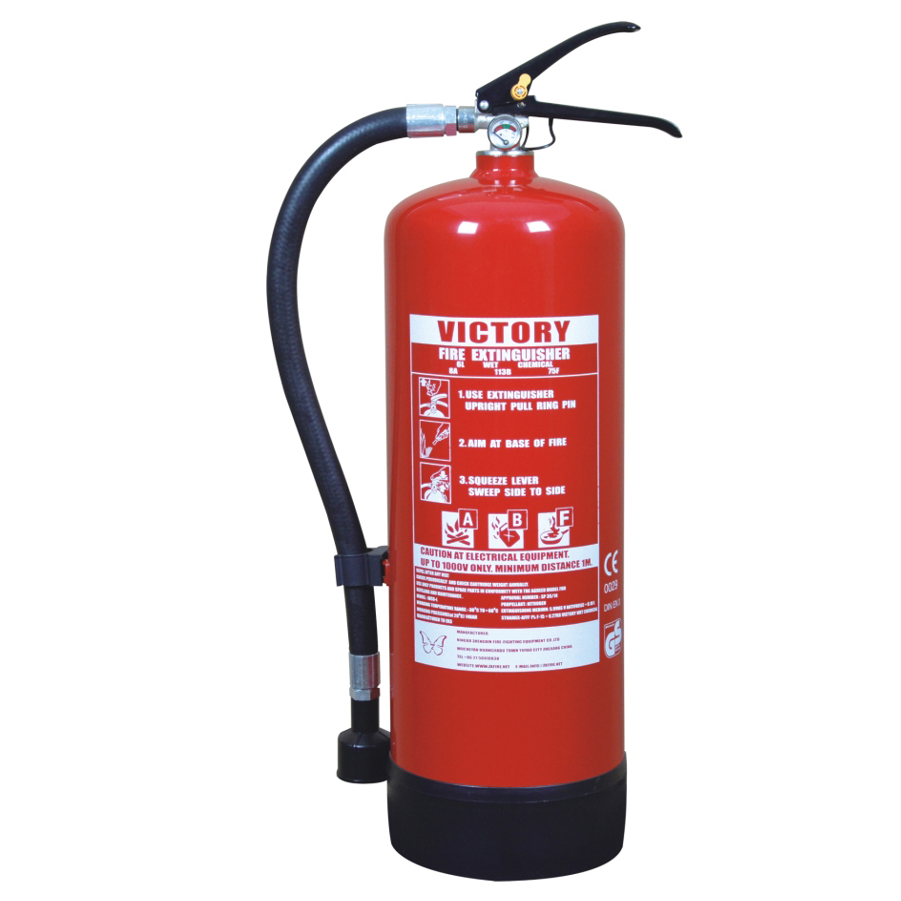
Selecting the right size requires precise calculation. Commercial kitchens vary dramatically in their cooking volumes. A small bakery utilizes entirely different equipment than a large industrial food processing plant. You must match the suppression capacity to the specific surface area of your cooking media.
Let us break down the standard capacity options:
6-Liter Units: These represent the industry standard. They work effectively for most mid-sized commercial kitchens, ghost kitchens, and standard restaurant lines. They hold enough agent to secure single-vat fryers and moderately sized griddles.
9-Liter Units: Heavy-duty environments require significantly more volume. High-volume industrial food processing facilities depend on these larger models. Massive multi-vat fryer banks demand higher Wet Chemical capacities to guarantee complete saponification across a large surface area.
Beyond volume, you must analyze your environmental and temperature risks. Standard extinguishing agents contain a high volume of water. They perform flawlessly in climate-controlled indoor kitchens. However, they introduce severe liabilities in freezing environments.
Consider the modern food service landscape. Food trucks operate outdoors year-round. Caterers set up temporary kitchens in freezing weather. Unheated warehouse ghost kitchens experience significant temperature drops overnight. If the water inside a standard cylinder freezes, the unit becomes completely useless. Ice expands, which can crack the internal dip tube or compromise the external cylinder welds.
For these demanding applications, you must specify a 6L anti-freeze wet chemical fire extinguisher. Manufacturers engineer these specialized units with proprietary additives. These chemical additives drastically lower the freezing point of the agent. They ensure immediate operational readiness even when temperatures plunge below freezing. This specific choice prevents wintertime fire disasters in mobile and outdoor settings.
Finally, utilize feature-to-outcome mapping for the physical hardware. Commercial kitchens breed aggressive corrosion. High humidity, airborne grease, and harsh acidic cleaning chemicals rapidly destroy cheap carbon steel. Always prioritize stainless steel cylinders. Stainless steel resists rust, withstands daily abuse, and maintains its structural integrity over a decade of service.
Kitchen Environment Type | Recommended Capacity | Freezing Risk Level | Optimal Cylinder Material |
|---|---|---|---|
Standard Indoor Restaurant | 6-Liter | Low | Stainless Steel |
Industrial Food Processing Plant | 9-Liter | Low | Stainless Steel |
Year-Round Food Truck | 6-Liter Anti-Freeze | High | Stainless Steel |
Outdoor Winter Catering Setup | 6-Liter Anti-Freeze | High | Stainless Steel |
Even seasoned facility managers stumble during the procurement process. Overlooking subtle details leads to rejected inspections and dangerous working conditions. We have identified the most common pitfalls to help you protect your investment.
Misunderstanding Extinguisher Ratios: Many operators purchase a single unit and assume they achieved compliance. They fail to map the number of extinguishers to the surface area of their fryers. NFPA codes dictate specific coverage limits per unit. A massive cooking line with four separate fryers often requires multiple units spaced strategically. Buying too few units leaves your staff vulnerable during a massive flare-up.
Ignoring the Hose and Wand Design: The applicator wand is an essential engineering feature, not an optional accessory. Dispensing the agent directly from a standard nozzle creates a harsh, high-velocity stream. This stream agitates the deep fryer, splashing boiling grease onto the user. The extended applicator wand keeps the operator at a safe physical distance. It also disperses the agent gently over the hazard, allowing the foam blanket to form without disturbing the oil below.
Buying Solely on Price: Budget constraints push many buyers toward cheap online marketplaces. Highlighting the hidden costs of cheap imports is crucial. Discounted units frequently lack independent laboratory testing. They look identical to compliant models but fail to pass fire marshal audits. The inspector will red-tag the equipment. You then face immediate hidden costs, as you must repurchase fully certified units on a rush order to reopen your kitchen. Prioritize quality and certification over a slight initial discount.
Acquiring the correct equipment represents only half the compliance equation. Proper installation and rigorous ongoing maintenance ensure the unit functions perfectly during an emergency. Fire codes strictly regulate both aspects.
You cannot simply place the cylinder on a shelf or tuck it into a corner. Inspectors strictly enforce mounting heights and placement logistics.
The unit must be located along the primary path of egress. In an emergency, operators should walk toward an exit to retrieve the device, not deeper into a dangerous kitchen.
Codes typically mandate a maximum travel distance. The extinguisher must remain no further than 30 feet from the primary hazard area, such as the fryer or griddle bank.
Never mount the unit directly over the hazard. If the fryer ignites, the resulting flames and heat plume will block physical access to the extinguisher. Place it safely adjacent to the cooking zone.
Fire safety equipment requires a strict, documented schedule of care. Neglecting maintenance guarantees the unit will fail when you need it most.
Monthly visual inspections: Staff members must perform brief checks every 30 days. They must verify the pressure gauge reads in the green zone. They should ensure the safety pin remains intact and the tamper seal remains unbroken. The unit must also be clean and physically unobstructed.
Annual professional servicing: A state-certified fire safety technician must visit your facility once a year. They conduct a thorough mechanical inspection, check for internal corrosion, verify the agent weight, and attach a new certification tag.
Hydrostatic testing intervals: The metal cylinder undergoes tremendous internal pressure. Local codes usually require a hydrostatic pressure test every 5 or 12 years. Technicians empty the cylinder, fill it with water, and pressurize it beyond normal limits. This ensures the structural welds can still safely contain the operational gases.
Securing a commercial kitchen requires precision, diligence, and strict adherence to safety codes. You must deploy shortlisting logic to streamline your procurement process. First, definitively confirm your Class K requirement for any combustible cooking media. Second, calculate the exact volume and size needed based on your specific fryer capacity and surface area. Third, factor in unique temperature needs, selecting anti-freeze models if your environment drops below freezing. Finally, always verify the UL or ULC listing to guarantee reliability.
Do not wait for an inspection failure to upgrade your equipment. We advise every facility manager to audit their current cooking footprint today. Review your existing extinguishers, check their tags, and measure your travel distances. Consult with a certified fire safety vendor to assess your space. They will help you procure the exact models required to satisfy the law and protect your staff.
A: No. Dry chemicals do not prevent grease fire re-ignition and can easily spread burning oil across the kitchen. The powder cannot cool the oil below its auto-ignition temperature. Local and national fire codes mandate Class K (Wet Chemical) exclusively for commercial cooking media.
A: While the physical stainless steel cylinder can last 10-12 years with proper hydrostatic testing, the internal chemical agent requires regular attention. Facilities typically require professional discharging, inspection, and recharging every 5 years, though this timeframe varies based on your local municipal code.
A: Yes. NFPA 10 strictly requires portable Class K extinguishers as a manual backup to fixed automatic hood fire suppression systems. You use the portable unit for minor flare-ups before the hood activates, or as a critical fail-safe if the automatic system malfunctions.
A: It prevents the liquid extinguishing agent from freezing. Standard agents freeze in cold weather, which can crack the cylinder or render the unit useless. Anti-freeze models are absolutely essential for maintaining operational readiness in food trucks, unheated ghost kitchens, and outdoor commercial cooking setups.


