
Views: 0 Author: Site Editor Publish Time: 2026-08-12 Origin: Site


Selecting the wrong extinguisher capacity is a critical safety mistake. It risks failing strict compliance audits. Worse, it makes the equipment physically unusable for staff during an emergency. Facility managers often struggle balancing fire-fighting capability alongside user ergonomics.
A Dry Chemical Powder Extinguisher offers exceptional versatility. It handles Class A, B, and C fires effectively. However, the internal powder capacity dictates much more than mere fire suppression power. Volume strictly controls discharge time, coverage area, and physical handling requirements.
This article provides a standardized, evidence-based framework. You will learn to evaluate, size, and shortlist dry powder units. We will help you match exact capacities to specific site hazards. Read on to master compliance standards, usability trade-offs, and procurement best practices.
Match Capacity to Hazard Level: Light hazards require significantly less volume (e.g., 2kg to 4kg) than industrial or chemical storage areas (9kg to 12kg+).
Beware of the Gross Weight Trap: A 9kg powder capacity translates to a gross weight of roughly 13–15kg, directly impacting operator usability and deployment speed.
Compliance is Non-Negotiable: Ensure capacities align with local fire codes (e.g., NFPA 10 requirements for travel distances or specific rating minimums for an EN dry powder extinguisher).
Volume vs. Precision: Larger capacities offer longer discharge times but require thorough staff training to manage the forceful discharge effectively.
You must first define clear success criteria for your facility. The ultimate goal is providing adequate extinguishing agent. It must suppress a fire before the flames spread. Crucially, the unit cannot exceed the physical handling limits of an average user. Achieving this balance requires mapping your environment into specific hazard categories.
Light or low hazard areas include offices, classrooms, or waiting rooms. These spaces contain limited amounts of combustible materials. Combustibles mainly consist of paper, wood, and standard furnishings. The primary requirement here involves smaller capacities. Compact units handle incidental, small-scale fires perfectly. They prevent minor incidents from escalating into structural threats.
Ordinary or moderate hazard areas pose a slightly higher risk. Retail spaces, light manufacturing floors, and parking garages fit this profile. Combustible loads are denser. Flammable liquids might be present in small quantities. The requirement shifts to mid-range capacities. Mid-sized units suppress spreading fires involving moderate amounts of Class A or B combustibles.
Extra or high hazard areas demand the highest level of protection. Fuel storage depots, chemical processing plants, and heavy manufacturing zones classify as extra hazards. Commercial kitchens also fall here regarding their non-grease areas. The requirement demands maximum portable capacities. Sometimes, facilities must deploy large wheeled units. These environments need rapid, high-volume suppression to avert catastrophic losses.
Below is a standardized summary mapping hazard levels to typical required capacities.
Hazard Classification | Typical Facility Examples | Recommended Capacity Range |
|---|---|---|
Light (Low) Hazard | Offices, Classrooms, Waiting Areas | 2kg to 4kg |
Ordinary (Moderate) Hazard | Retail Floors, Parking Garages, Clinics | 4kg to 6kg |
Extra (High) Hazard | Fuel Storage, Workshops, Chemical Plants | 9kg to 12kg (or Wheeled Units) |
Understanding standard capacities helps streamline your procurement process. Manufacturers design specific sizes for distinct operational environments. Let us break down the standard weight classes commonly found in commercial settings.
1kg to 2kg Units (Targeted / Vehicle Use):
These highly compact units serve a very narrow purpose. They are best for fleet vehicles, forklifts, and small electrical panels. Because of their size, they mount easily inside tight cabins. However, they carry severe limitations. The discharge time is incredibly short. Most empty in under 10 seconds. You should never use them for primary building protection. They simply lack the volume to handle structural fires.
4kg to 6kg Units (The Commercial Standard):
This size represents the backbone of modern fire safety. They are best for standard office corridors, retail floors, and general facility compliance. The pros are significant. A 6kg unit perfectly balances adequate fire-fighting power. They typically offer a 13A to 21A rating. Furthermore, they maintain ergonomic handling for most adults. Staff can carry them swiftly without suffering severe fatigue.
9kg to 12kg Units (Industrial & High-Risk):
You deploy these units in highly volatile environments. They are best for warehouses, heavy workshops, and fuel transfer sites. The pros include maximum portable fire-fighting capacity. They deliver a sustained, powerful discharge. The cons involve severe usability restrictions. They are extremely heavy. A 9kg powder unit often weighs 15kg in total. Facility managers must implement deliberate mounting considerations. You also need strict staff physical capability assessments.
25kg to 50kg+ Wheeled Units (Heavy Industry):
These massive units substitute stationary suppression systems. They are best for aviation hangars, large-scale chemical plants, and offshore platforms. Implementation requires careful site planning. Operators need flat, clear pathways for deployment. Wheeled units cannot navigate stairs. They demand specialized training to maneuver safely during an emergency.
You cannot purchase fire safety equipment based solely on raw weight. Regulatory bodies test units to guarantee performance. Understanding alphanumeric ratings clarifies actual fire suppression power. Capacity directly correlates to UL and EN ratings.
A rating like 21A means the unit extinguished a specific size of wood crib fire during laboratory testing. Larger powder volumes generally achieve higher A and B ratings. A 6kg unit might achieve a 21A rating. Meanwhile, a 9kg unit might reach a 34A or 43A rating. You must align these numbers against local fire codes.
European standards dictate precise manufacturing and performance criteria. When procuring an EN Dry Powder Extinguisher, you must look for specific markings. Always verify the presence of a CE marking. For portable units, ensure strict EN3 compliance. Wheeled units must comply under EN1866 standards. These certifications guarantee cylinder integrity, valve reliability, and consistent powder flow.
NFPA 10 alignment adds another layer of complexity. American standards factor in strict travel distance requirements. Operators should not run excessive distances to fetch a unit. For ordinary hazards, NFPA usually restricts travel distance to 75 feet for Class A fires. This creates an important decision checkpoint for managers.
Is it better to have two strategically placed 6kg units? Or should you install one 12kg unit to meet maximum travel distance regulations? Usually, multiple smaller units provide better coverage. They reduce walking distance and ensure faster deployment. They also limit physical strain on the responding employee.
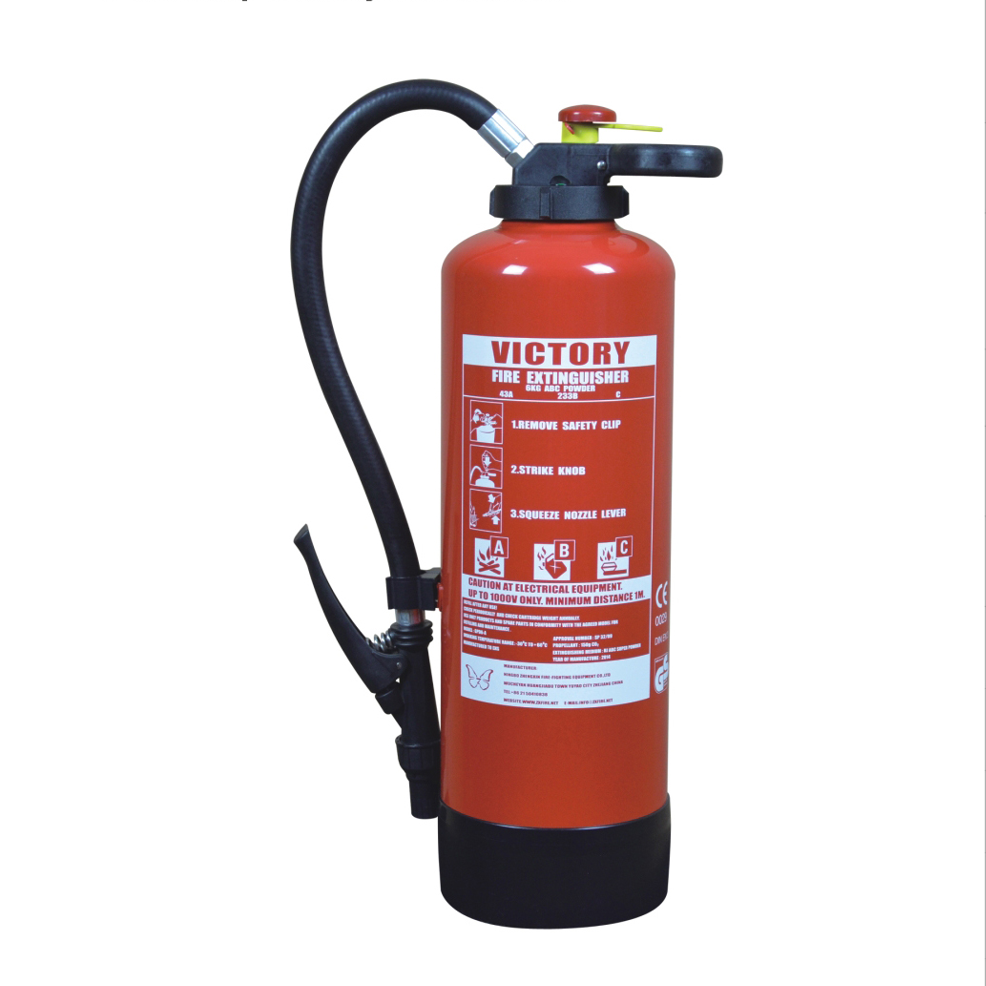
Managers often assume bigger always equals better. This dangerous misconception ignores human physical limits. The gross weight trap catches many inexperienced safety officers. You must clarify labeled sizes immediately.
A dry powder extinguisher's labeled size represents only the chemical weight. A 9kg unit holds exactly nine kilograms of monoammonium phosphate. It does not weigh nine kilograms. The thick steel cylinder adds significant mass. The heavy-duty brass valve, siphon tube, and reinforced hose add further bulk. A fully assembled 9kg unit regularly exceeds 14 kilograms. This gross weight drastically reduces operator agility.
You must assess operator demographics carefully. Consider who will actually use the equipment. An aging workforce or staff unused to heavy lifting will struggle. Oversizing equipment can cause staff to drop the unit in panic. They might fail to aim it correctly while supporting its massive weight. A poorly aimed heavy unit wastes powder faster than a well-aimed small unit.
The "powder cloud" reality presents another crucial hazard. Dry chemical units suppress fire by interrupting the chemical reaction. They achieve this by discharging a massive cloud of fine monoammonium phosphate dust. Larger capacities produce exponentially larger clouds.
This dense cloud rapidly obscures vision. It coats escape routes in a thick layer of white or yellow powder. Furthermore, inhaling the dust limits breathing and causes mild respiratory irritation. In confined spaces, discharging a 12kg unit creates total blindness within seconds. Smaller, strategically placed units often prove safer indoors. They suppress the fire without destroying visibility along critical egress routes.
Facility managers need an actionable strategy to implement these insights. Blindly ordering units from a catalog invites compliance failures. You should initiate the procurement process by conducting precise site audit mapping.
Walk your entire facility methodically. Identify specific Class A, B, and C risks in every room. Assign concrete hazard levels to each distinct zone. A warehouse holding cardboard requires a different approach than a server room adjacent to it. Documenting these specific zones prevents dangerous under-protection.
Standardizing equipment sizes yields massive operational benefits. Avoid mixing and matching too many random sizes across the building. Having 2kg, 4kg, 6kg, and 9kg units scattered everywhere confuses staff. Instead, standardize on a 6kg capacity for all general areas. Use 9kg units exclusively for high-risk loading docks or mechanical rooms. Standardization simplifies annual training. It also streamlines recurring maintenance protocols.
Evaluating vendor trustworthiness protects your investment. Look closely for transparent product data sheets. Reliable manufacturers specify actual discharge times, effective spray ranges, and standard operating pressures. Review the warranty terms carefully. Demand verifiable regulatory stamps stamped directly into the metal. Look for UL/ULC markings, the BSI Kitemark, or official CE stamps.
Finally, keep long-term maintenance cost considerations in mind. Fire extinguishers require regular servicing. Larger extinguishers or wheeled units carry substantially higher recharge fees. Hydrostatic testing costs also scale upward based on cylinder size. Facility budgets must account for these mandatory 6-year and 12-year servicing milestones.
Choosing the correct capacity requires balancing suppression power against human limits. You must base your final capacity decision on strict hazard classification. Ensure every selected unit firmly aligns alongside local regulatory codes.
Never ignore the physical capabilities of your daily workforce. A massive extinguisher provides zero value if an employee cannot lift it. Optimize your selection to guarantee fast, safe deployment during chaotic emergencies.
We urge all buyers to conduct a documented fire risk assessment. Finish this crucial step before executing any bulk purchase order. Doing so guarantees a compliant, safe, and highly defensible safety infrastructure.
A: Yes, it can suppress an incipient or early-stage car fire. However, its small volume results in an extremely short 8 to 10-second discharge time. This short window means your accuracy is absolutely critical. You must aim at the base of the flames immediately. It is not suitable for fully involved vehicle fires.
A: ABC powder contains monoammonium phosphate. It successfully handles standard combustibles, flammable liquids, and electrical fires. BC powder contains sodium or potassium bicarbonate. It only handles flammable liquids and gases. Your capacity needs may shift based on the specific chemical efficiency required by your site hazards.
A: A standard 6kg unit typically delivers 15 to 20 seconds of continuous discharge. The exact time depends heavily on the specific valve design and the manufacturer's internal pressure rating. Operators should use sweeping motions to maximize this brief window of suppression.
A: Yes. Under NFPA 10 and EN codes, travel distance limits depend on both the hazard level and the specific rating of the extinguisher. The rating is directly tied to the unit's capacity. Larger capacities often allow slightly extended travel distances, but smaller units require tighter spacing.


