
Views: 0 Author: Site Editor Publish Time: 2026-07-23 Origin: Site


Commercial kitchens operate in a highly volatile environment. Massive heat sources and continuous activity create distinct fire hazards every single day. The most severe threat remains cooking oil fires, where animal fats ignite at dangerous temperatures. Choosing a proper response tool is not merely a basic safety measure. It remains a strict legal compliance issue and a mandatory commercial insurance requirement. Facilities managers face significant liability if they select inadequate equipment. This guide provides a strictly objective, criteria-based framework. We will help business owners evaluate, shortlist, and purchase the exact unit needed for safety and compliance. You will learn the exact science behind these specialized agents. You will understand vital sizing standards for different commercial fryers. Finally, you will discover how to verify crucial regulatory benchmarks to perfectly protect your staff, property, and ongoing business operations.
Optimal Sizing: The 6L capacity is the industry sweet spot for commercial deep fryers, balancing adequate discharge volume with manageable physical weight.
Scientific Mechanism: These units work via saponification—converting burning fats into a cooling, non-combustible soapy layer.
Compliance is Mandatory: Purchasing decisions must align with regional fire codes (e.g., BS EN3, UL) and specific commercial insurance policies to avoid liability.
Commercial kitchens require a rapid-response tool for deep fryer fires. A standard 3L unit often lacks the volume to fully extinguish a large flare-up. Conversely, a 9L unit becomes too heavy for all staff members to handle efficiently during a panic. You need an optimal middle ground. The 6L capacity perfectly bridges this gap between raw extinguishing power and user accessibility.
The sizing logic directly relates to standard cooking equipment. Six liters of specialized wet chemical agent typically covers a standard commercial fryer capacity. This usually translates to a maximum of 75 liters of cooking oil. Fire safety bodies represent this capability with a 75F rating. When you match the extinguisher size to the fryer size, you ensure complete fire suppression without dangerous re-ignition risks.
Physical handling limits dictate safety during an emergency. We must consider the physical capabilities of diverse kitchen teams. Handling heavy equipment during a crisis often leads to accidents. A standard 6L kitchen fire extinguisher maintains an operational weight that remains practical for nearly everyone.
Total Weight: A fully charged 6L unit weighs approximately 11 to 12 kilograms.
Ergonomics: This weight allows users to carry the unit swiftly across a busy kitchen floor.
Stability: It remains light enough for an operator to hold steady while aiming the extended lance.
You will find these specific units mandated across multiple high-risk environments. Restaurants represent the most common application scope. Industrial catering facilities also rely heavily on this exact specification. Food processing plants utilizing large vats of hot oil consider the 6L format strictly non-negotiable for baseline safety.
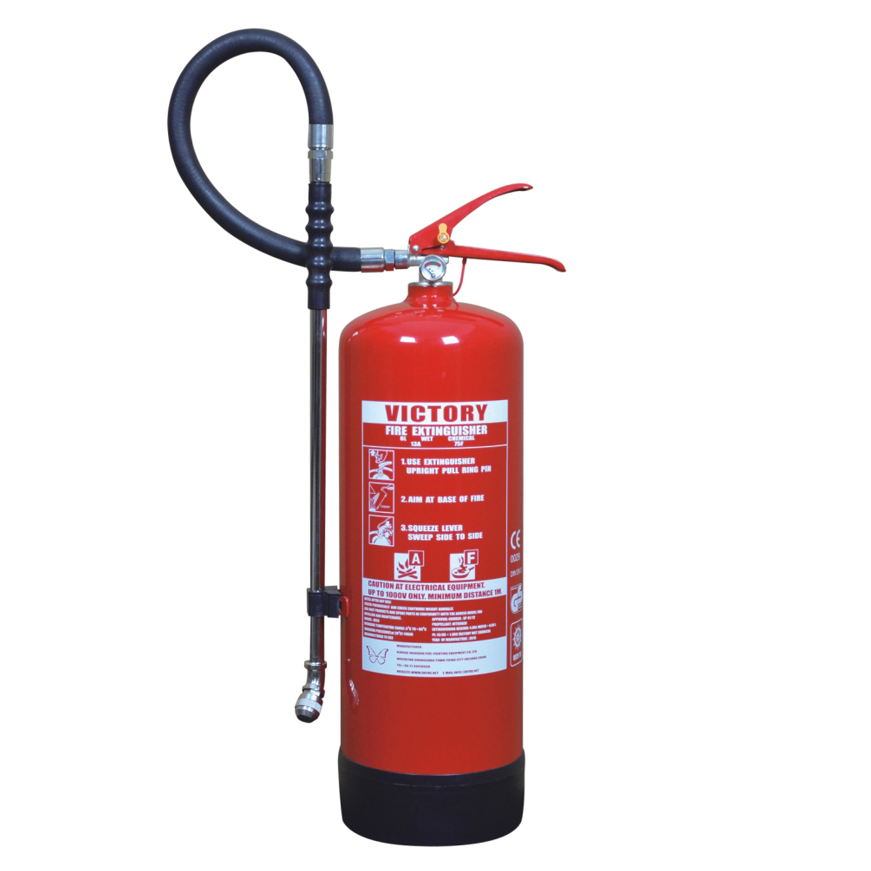
You must understand the science of saponification to evaluate these units properly. Burning oil reaches temperatures exceeding 340°C. Water or standard foam will cause massive, explosive flare-ups. Instead, wet chemical agents introduce a specialized alkaline mixture. This mixture reacts immediately with the hot fatty acids. It converts the burning oil into a thick, soapy crust.
This reaction achieves two critical goals. First, it drops the temperature of the oil rapidly. Second, the soapy blanket completely cuts off the oxygen supply. The agent must successfully blanket the oil, cool the heat source, and prevent re-ignition. Without this exact chemical process, a deep fryer fire remains almost impossible to control safely.
Global fire safety organizations classify cooking oil fires differently depending on your region. Buyers must look for specific alphanumeric ratings on the cylinder label. A true high efficiency wet chemical extinguisher will proudly display these verified performance metrics.
Table: Regional Fire Class Ratings for Cooking Oils
Region | Fire Class | Typical 6L Rating | Primary Application |
|---|---|---|---|
Europe / Australasia | Class F | 75F | Up to 75 liters of cooking oil |
United States | Class K | Standard Class K | Commercial deep fryers |
You will often notice secondary ratings on these devices. Many high-efficiency models carry a 13A rating. The "A" signifies ordinary combustibles. Kitchens contain plenty of cardboard boxes, paper towels, and wooden pallets. A dual-rated unit allows staff to tackle multiple fire types without guessing which cylinder to grab.
Discharge time and range serve as vital performance metrics. You do not want a powerful, aggressive jet of liquid hitting hot oil. That causes burning grease to splatter across the room. A quality unit delivers a slow, gentle discharge. The nozzle diffuses the liquid into a fine mist. This continuous discharge should last over 40 seconds. A prolonged spray ensures the entire surface area receives an even, cooling coat of the chemical agent.
Selecting fire safety equipment requires strict adherence to regulatory standards. You cannot simply trust marketing claims. Independent testing laboratories must verify the unit's performance. The specific marks you look for will depend entirely on your geographical location.
CE Mark: Mandatory for equipment sold within the European Economic Area.
BSI Kitemark: Indicates compliance with BS EN3 standards in the United Kingdom.
UL Listing: The gold standard for safety verification in the North American market.
Commercial property insurers pay close attention to your fire safety choices. They require specific extinguisher placements. Insurers explicitly dictate the types of agents allowed near cooking equipment. If a fire occurs, adjusters will immediately inspect your extinguishers. Non-compliance can void insurance payouts entirely in the event of catastrophic property loss.
Applicator design matters just as much as the chemical inside. Standard hoses fail in commercial kitchens. You must select units featuring an extended lance applicator. This long metal rod provides crucial distance. It allows the operator to stand far back from the intense radiant heat. The tip of the lance ensures the chemical falls gently onto the fire rather than jetting directly into the deep fryer. This design prevents severe user burns and stops fire from spreading to adjacent counters.
Always review your local fire code before purchasing. Some municipalities require specific signage above the unit. Others dictate exact mounting heights to ensure accessibility for all staff. Do not treat these rules as suggestions. They form the foundation of a legally compliant kitchen.
Commercial kitchens present a uniquely harsh environment. Airborne grease, high humidity, and frequent cleaning chemicals degrade equipment quickly. When evaluating options, you must scrutinize the build quality and the cylinder materials.
Many standard extinguishers use mild steel cylinders. Manufacturers line the inside with protective coatings to prevent rust. However, premium options utilize stainless steel. Stainless steel naturally resists corrosion from both the external kitchen environment and the internal alkaline chemical. A 6l wet chemical fire extinguisher built with superior materials will easily outlast cheaper alternatives in a demanding restaurant setting.
You must also confirm that any shortlisted model is fully refillable. Single-use extinguishers do not belong in a commercial setting. Once discharged, a professional fire safety technician must be able to clean, inspect, and recharge the unit on-site or at their facility.
Understanding service intervals helps you plan your operational workflow. Fire safety equipment is not a "set and forget" investment. Local fire codes mandate strict maintenance schedules.
Daily/Weekly Checks: Staff must visually confirm the pressure gauge sits in the green zone.
Annual Visual Inspections: A certified technician checks for external damage, hose blockages, and weight consistency.
Extended Service: Every five years, the cylinder undergoes a complete discharge test, internal inspection, and fresh chemical refill.
Local supplier support plays a massive role in maintaining compliance. You need a partner who responds quickly. If a unit loses pressure, you cannot legally operate your fryers until a replacement arrives. Choose suppliers who offer immediate service dispatch.
Buyers often face choice paralysis when viewing catalogs. You can simplify your decision by mapping specific hardware features to direct operational outcomes. We developed a feature-to-outcome matrix to guide your evaluation process.
Chart: Feature-to-Outcome Matrix
Hardware Feature | Operational Outcome |
|---|---|
Squeeze grip operation | Ensures intuitive use under panic. Reduces training friction. |
High-visibility pressure gauge | Allows for instant daily operational checks by floor staff. |
Wall-mounting brackets included | Ensures immediate compliance with mounting height regulations. |
Protective base skirt | Prevents floor damage and protects the cylinder base from rust. |
Your supplier vetting logic requires a strategic approach. We strongly advise buyers to prioritize dedicated B2B safety suppliers. Generic B2C online retailers often ship units without commissioning certificates. Without this vital paperwork, your local fire inspector will likely fail your kitchen during an audit.
Professional B2B suppliers offer comprehensive installation services. They provide on-site certification upon delivery. Furthermore, they offer ongoing maintenance contracts. This shifts the burden of compliance tracking from your shoulders to their specialized systems.
Finally, consider ecosystem integration. Extinguishers represent only one half of a complete solution. You should always pair wet chemical units with highly rated fire blankets. specifically, look for blankets compliant with the BS EN 1869 standard. A heavy-duty fire blanket handles small pan fires rapidly without creating a chemical mess. You reserve the 6L extinguisher for major fryer emergencies, creating a tiered, highly effective response strategy.
Selecting the ideal 6L unit involves much more than picking the first option from a catalog. It fundamentally requires matching the specific extinguishing capacity to your commercial fryer size. You must evaluate the chemical mechanism, verify regional safety ratings, and ensure the physical applicator design protects your team. Most importantly, your choice must maintain strict legal and insurance compliance at all times.
Take immediate action to secure your facility. We recommend conducting a formal Fire Risk Assessment (FRA) of your entire kitchen space this week. Identify exactly where your high-risk zones lie. Once mapped, contact a certified fire safety equipment supplier to request a tailored hardware quote. Protecting your staff and your livelihood starts with deploying the right tools before the emergency happens.
A: Some modern wet chemical units pass a 35kV conductivity test. This means an accidental spray on live equipment will not electrocute the user. However, they are not designed for electrical fires. Power to the kitchen equipment should always be cut first before deploying any liquid agent.
A: These units follow a standard 5-year discharge and refill cycle. If maintained properly, the metal cylinder itself boasts a typical overall lifespan of 10 to 20 years. The unit must continually pass strict pressure testing during its extended service intervals to remain in active duty.
A: Mount the unit near the exit doors of the kitchen space. It must remain easily accessible along the primary escape route. Never install an extinguisher directly above or immediately next to the deep fryers. A sudden fire would physically block staff from reaching the equipment safely.


