
Views: 0 Author: Site Editor Publish Time: 2026-07-18 Origin: Site


Managing commercial fire risk requires balancing rapid suppression capabilities against strict regulatory compliance. Facility managers frequently operate in mixed-risk environments. In these spaces, a single hazard type rarely poses the only threat. Combustible packaging materials often sit adjacent to flammable liquid storage. Relying solely on standard water units can leave dangerous gaps in your safety net.
Selecting the correct extinguisher capacity and discharge mechanism remains absolutely critical to operational safety. A mismatched unit worsens emergency situations rather than resolving them. This guide evaluates the operational advantages, limitations, and compliance criteria of the 9l foam fire extinguisher. You will learn how to determine if it aligns alongside your specific facility risk profile. We will also explore crucial environmental regulations and strategic placement methodologies to enhance your emergency readiness.
Dual-Risk Coverage: 9L foam units provide high fire ratings for both Class A (combustible materials) and Class B (flammable liquids) fires, reducing the need for multiple distinct extinguisher types.
Volume & Reach: The 9-liter capacity offers extended discharge times and greater throw ranges, critical for mitigating larger commercial fire risks before emergency services arrive.
Maintenance Efficiency: A store pressure foam extinguisher model provides visual pressure verification, lowering routine inspection friction compared to cartridge-operated alternatives.
Regulatory Shift: Buyers must account for evolving environmental regulations regarding PFAS (forever chemicals) when sourcing AFFF (Aqueous Film Forming Foam) or transitioning to fluorine-free alternatives.
Commercial spaces present complex, multi-class fire risks on a daily basis. Warehouses, manufacturing floors, and fuel storage areas contain diverse combustible materials. Forklifts leak hydraulic fluid near massive stacks of cardboard inventory. Paint shops store volatile solvents next to wooden pallets. A standard water extinguisher often proves insufficient in these environments. Using pure water on flammable liquids creates extreme danger. It causes burning fuel to splash, spreading the fire rapidly across the facility floor. You must deploy versatile suppression tools to manage these dynamic risks safely.
Procurement teams measure success using strict criteria to protect personnel and assets. First, equipment must meet local fire safety legislation. Frameworks like the BS 5306 standards mandate specific coverage ratios and maintenance schedules. Second, facilities must achieve a minimum fire rating for their calculated floor area. Fire safety inspectors look for these specific ratings during annual audits. Finally, safety officers strive to minimize equipment variation. Fewer extinguisher types simplify staff training significantly. This streamlined approach drastically reduces panic-induced errors during an emergency deployment.
The 9-liter capacity serves as an enduring industry benchmark for commercial sites. It typically provides standardized 21A or 27A ratings for solid combustibles. It also delivers a robust 183B or higher rating for flammable liquids. This specific capacity offers the optimal balance between manual handling weight and maximum suppression duration. Commercial-scale incidents demand extended discharge times. A 9-liter unit provides the necessary volume to suppress growing flames effectively before local emergency services arrive on the scene.
Understanding suppression mechanisms helps you deploy equipment effectively when seconds matter. The 9-liter unit excels because it attacks fires on two completely different fronts. For Class B flammable liquid fires, it utilizes a highly effective smothering mechanism. Aqueous Film Forming Foam (AFFF) rapidly spreads across the burning liquid surface. It creates a durable vapor-sealing barrier. This barrier cuts off the oxygen supply entirely. It also traps flammable vapors underneath, preventing sudden re-ignition. Water alone cannot achieve this outcome. It simply sinks below the lighter fuel, boiling rapidly and expanding the hazard zone.
For Class A combustible fires, foam provides a powerful, sustained cooling effect. The foam solution consists mostly of water mixed with special chemical agents. This high water content rapidly reduces the temperature of burning solids. It cools materials like wood, paper, and textiles well below their ignition point. Furthermore, the active agents reduce water surface tension. This change allows the liquid to deeply penetrate the burning material rather than just wetting the surface. It secures the hazard from the inside out.
Facility managers must clearly understand the 35kV dielectric test reality. Many modern 9-liter units proudly pass this rigorous electrical conductivity test. This means accidental discharge on electrical equipment up to one meter away is less likely to cause fatal electrocution to the operator. However, you must interpret this correctly. It does not mean they are safe for electrical fires. They are strictly not intended or rated for Class C electrical hazards. The liquid will conduct electricity over shorter distances. It also causes irreversible corrosion damage to sensitive electronic server components. Co-placement alongside dedicated CO2 units remains absolutely mandatory in all modern commercial spaces.
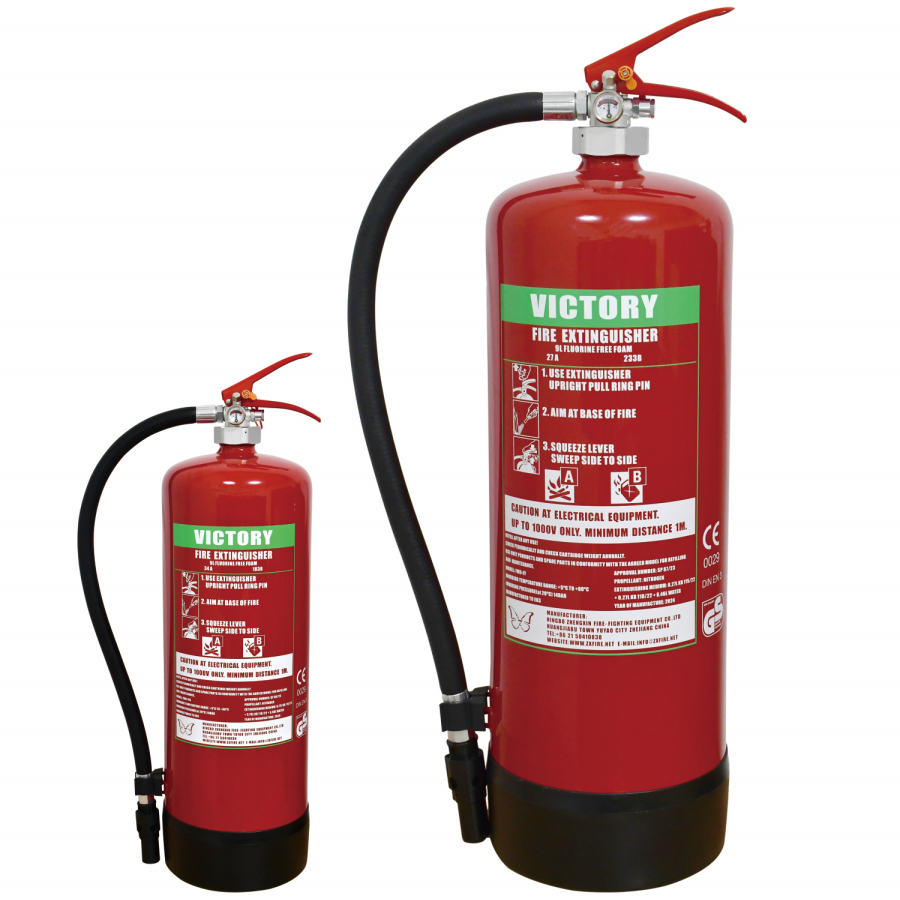
Commercial buyers generally choose between two primary mechanical designs. Understanding these distinct solution categories ensures you select the right deployment mechanism. The physical environment and your maintenance infrastructure heavily dictate the best choice.
We highly recommend the store pressure foam extinguisher for the vast majority of commercial use cases. In this straightforward design, the nitrogen propellant and foam solution share the same pressurized cylinder. They remain under constant, uniform pressure year-round. Users can easily verify operational readiness. A quick glance at the external pressure gauge confirms the unit remains fully pressurized. They feature much lower initial procurement costs. They also contain fewer internal moving parts, significantly reducing mechanical failure risks over their lifespan. However, they do require precise repressurization using specialized equipment during their standard five-year extended service.
Cartridge-operated models serve niche, heavy industrial applications. In these units, the gas propellant resides securely in a separate internal cartridge. The operator pierces this cartridge upon physical activation to pressurize the main cylinder. Technicians can easily refill them on-site in remote locations without hauling bulky nitrogen tanks. Their highly rugged design withstands extremely harsh, corrosive environments better than standard units. Unfortunately, they demand a higher upfront cost. They also lack an at-a-glance external pressure gauge. Safety inspectors must physically open the unit and weigh the internal cartridge to verify emergency readiness. This dramatically increases routine maintenance time.
Design Comparison Table
Feature Category | Store Pressure Design | Cartridge-Operated Design |
|---|---|---|
Visual Readiness Check | Instant verification via external gauge | Requires weighing the internal cartridge |
Initial Procurement Cost | Low to Moderate | High |
Maintenance Complexity | Requires shop repressurization | Allows remote, on-site refilling |
Primary Use Case | Offices, warehouses, retail, general commercial | Mining, marine, heavy industrial sites |
Every fire safety strategy carries inherent implementation risks. Environmental and regulatory risks now completely dominate the conversation around liquid fire suppressants. We must address the PFAS factor transparently. Legislation globally is strictly driving the phase-out of traditional AFFF agents. These legacy foams contain per- and polyfluoroalkyl substances, commonly known as PFAS. Environmental authorities classify them as "forever chemicals" because they persistently refuse to break down in nature. They heavily contaminate local groundwater supplies and pose significant long-term ecological risks.
Industry standards are shifting rapidly to protect the environment. Facilities must aggressively evaluate the transition toward Fluorine-Free Foam (F3) alternatives. Modern F3 9-liter extinguishers perform exceptionally well under commercial testing conditions. However, you must carefully assess slight differences in their physical deployment properties. They often possess different fluid viscosities compared to legacy AFFF. This altered viscosity sometimes requires modified aspiration nozzles to create an effective, smothering foam blanket. Fire rating variations might also occur during this chemical transition. Always verify the specific numerical rating of an F3 unit before authorizing deployment in high-risk zones.
Post-fire clean-up requirements present another stark operational reality. Foam successfully knocks down flames, but it leaves a stubborn, sticky residue behind. This specific residue often requires professional remediation services to remove completely. Indoor environments still benefit vastly from foam over dry powder options. Powder ruins visibility instantly and poses severe respiratory hazards to escaping personnel. Still, foam presents secondary clean-up burdens for commercial assets. It can corrode unprotected metal surfaces over time if left untreated.
Weight constraints heavily influence physical deployment strategies. A fully laden 9-liter unit weighs approximately 14kg. This considerable weight challenges some staff members during manual handling or emergency transport. Evaluating the physical realities of your specific staff deployment remains essential. You must ensure proper wall mounting at ergonomic, easily reachable heights. Do not place them too high on warehouse pillars. Alternatively, utilize standardized heavy-duty plinths to keep them accessible yet secure on the floor.
Calculating facility requirements demands a highly systematic approach. Do not guess your coverage needs or rely on outdated floor plans. Use a reliable heuristic for floor area coverage. Standard pairing rules dictate specific equipment quantities per square meter. Regional fire codes outline these exact mathematical formulas. For example, baseline safety standards typically require one 13A rated unit per 200 square meters of floor space. A 9-liter foam unit easily exceeds this baseline, offering highly robust primary protection. You must calculate the square footage accurately to determine the total fleet required.
Strategic placement maximizes your suppression capabilities during the critical first two minutes of a fire. Locate units near known high-risk nodes. Fuel stores, loading docks, and machinery rooms require immediate access. Mount them prominently along all designated escape routes. Ensuring high visibility remains absolutely non-negotiable in commercial spaces. Train your staff periodically to recognize the standardized cream-colored label identifying foam units. Guarantee unhindered access at all times. Never block fire points with pallets or inventory in busy warehouses.
Follow these next-step actions for effective, compliant procurement:
Audit current fire risk assessments to confirm the exact prevalence of Class A and Class B hazards across your facility.
Verify supplier compliance regarding strict environmental standards, aggressively prioritizing certified Fluorine-Free (F3) chemical options.
Factor in long-term lifecycle maintenance scheduling, including the requisite annual basic service and the mandatory 5-year discharge and refill cycles.
Schedule professional on-site commissioning to validate the physical installation strictly matches your local fire safety codes.
The 9-liter capacity remains a foundational cornerstone of commercial fire safety. It delivers unmatched, dual-action efficacy on mixed Class A and B hazards.
Deploy these units strictly within a compliant, environmentally aware framework. Phase out older PFAS-containing agents promptly to avoid future regulatory penalties.
Favor store pressure mechanisms for general commercial environments. They massively simplify routine visual inspections and reduce mechanical failure points.
Base shortlisting decisions purely on independently verified fire ratings. Always strategically pair them with specific electrical risk extinguishers like CO2.
Take immediate action by reviewing your site's professional fire risk assessment today. Consult a certified maintenance technician to begin planning your facility's transition to modern, fluorine-free alternatives safely.
A: A 6L unit is lighter and easier for manual handling. It suits smaller risk areas perfectly. However, the 9l foam fire extinguisher provides a significantly higher fire rating. It also delivers the extended discharge time specifically required for larger commercial footprints and complex hazard zones.
A: No. While many modern units pass a 35kV dielectric test to prevent fatal shocks upon accidental contact, they are not classified for electrical fires. The liquid will severely damage electrical components. You must use a CO2 unit for electrical risks instead.
A: Staff must conduct a basic visual inspection monthly. A certified technician must perform professional maintenance annually. Under standard BS 5306 regulations, they require an extended service every 5 years. This includes a complete discharge, internal cylinder inspection, and fresh chemical refill.
A: Yes. Global legislation is heavily restricting and phasing out legacy AFFF containing PFAS. These forever chemicals cause severe environmental damage. Modern commercial procurement should strongly focus on certified, high-performance Fluorine-Free Foam (F3) alternatives to ensure long-term regulatory compliance.


