
Views: 0 Author: Site Editor Publish Time: 2026-07-22 Origin: Site


Commercial kitchens and large culinary setups face high-risk, high-temperature hazards from deep fat fryers and industrial ranges. Every service shift involves immense heat, volatile oils, and relentless pressure. Using standard ABC powder or water-based extinguishers on cooking oil causes explosive splatter and rapid fire spread. They actively worsen the emergency by displacing burning grease across the room. You simply cannot treat a deep fryer blaze like an ordinary paper or wood incident.
In this article, we evaluate the specific formulation and physical scale of the proper extinguishing solution. You will discover exactly why this specialized unit stands as the standard compliance and safety baseline for Class F (EU/UK) and Class K (US) fire risks. We will detail its chemical mechanics, optimal sizing protocols, and practical deployment strategies. By understanding these core elements, you can better protect your staff, salvage kitchen equipment, and ensure full alignment with commercial fire safety regulations.
Targeted Chemistry: Wet chemical agents utilize saponification to simultaneously smother and cool superheated cooking oils, preventing re-ignition.
Optimal Sizing: The 6-liter capacity provides the necessary discharge volume for commercial vats while remaining light enough for rapid, single-person deployment.
Regulatory Compliance: Deploying this specific unit meets stringent local fire codes (e.g., NFPA 10, BS EN3) for commercial cooking environments.
Operational Adaptability: Options like the anti-freeze wet chemical extinguisher ensure functionality in unheated setups like food trucks and mobile kitchens.
Cooking oils and animal fats ignite at exceedingly high temperatures. They often exceed 340°C (644°F) before catching fire. These extreme temperatures make them incredibly resilient to standard cooling methods. When a commercial fryer ignites, the entire volume of oil serves as a massive thermal battery. It continuously feeds the flames. Traditional suppression tools fail completely in this environment.
We must first examine the critical splatter risk. Pressurized water causes a violent steam explosion when it hits boiling oil. It instantly vaporizes, expanding rapidly and throwing flaming grease onto walls, ceilings, and nearby personnel. Standard dry chemical powder may temporarily knock down the visible flame. However, it provides zero cooling effect. The superheated oil simply auto-ignites seconds later. CO2 extinguishers operate under high pressure. Deploying CO2 blasts the burning oil out of the vat, creating secondary fires throughout the kitchen.
A viable solution must meet specific success criteria for extinguishment. It must drop the oil temperature below its auto-ignition threshold. It must also seal the liquid surface to cut off oxygen completely. Crucially, it must achieve both actions without agitating the volatile liquid beneath. Recognizing these strict parameters explains why commercial kitchens require dedicated, purpose-built suppression formulas.
When you deploy a wet chemical fire extinguisher, a highly specialized chemical reaction occurs. This process relies on a unique alkaline extinguishing agent. When this alkaline mixture contacts the hot fatty acids in cooking oil, it initiates a reaction called saponification.
Saponification instantly converts the top layer of the burning oil into a thick, non-combustible soap. This soapy crust floats on the surface, separating the fuel from the oxygen supply. The agent provides dual-action mitigation to neutralize the threat entirely:
Smothering: The thick soapy layer traps combustible vapors. It acts as an impenetrable blanket, blocking atmospheric oxygen from feeding the fire.
Cooling: The chemical agent contains a high water content. As it hits the extremely hot oil beneath the crust, this water turns to steam. The phase change pulls immense amounts of thermal energy out of the vat. This rapid cooling prevents the dreaded re-flash phenomenon.
The delivery mechanism proves just as important as the chemistry. You cannot apply this agent at high pressure. Manufacturers equip these units with a specialized lance and applicator nozzle. This elongated wand allows the operator to stand at a safe distance. The nozzle disperses the chemical as a gentle, low-velocity mist. It falls softly onto the surface of the oil. This fine spray prevents any agitation, ensuring the hot grease stays securely inside the vat while the saponification crust forms.
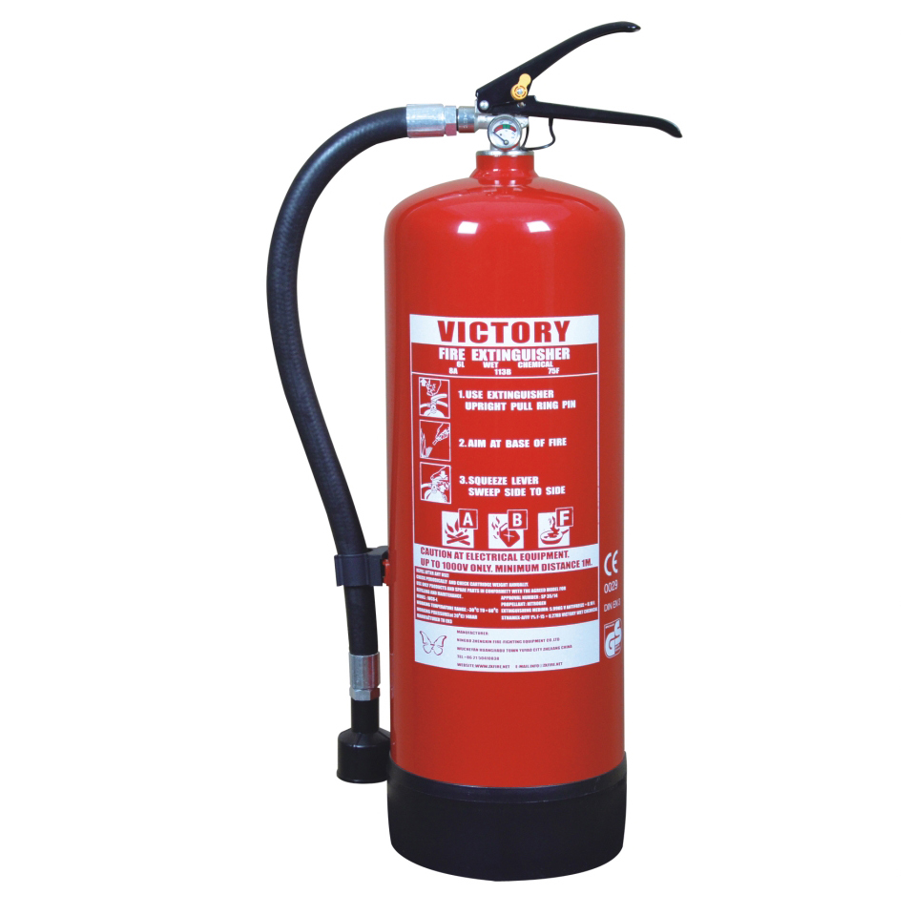
Commercial fire safety requires balancing available agent volume against ergonomic maneuverability. You might wonder why smaller or larger units are not the standard recommendation for busy kitchens.
Smaller capacities, such as 2L or 3L units, deplete far too quickly. Standard commercial deep fat fryers often hold up to 75 liters of oil. A fire in a vat this size requires sustained agent application to ensure a complete saponification seal. A small unit might cover half the surface before running empty, allowing the fire to surge back instantly. A 6L unit provides the necessary sustained discharge time. It typically sprays continuously for 40 to 45 seconds, securing larger surface areas effectively.
Conversely, scaling up presents severe usability issues. A 9L unit offers excellent coverage but can exceed 15kg in gross weight. In an emergency, adrenaline runs high, but heavy equipment reduces maneuverability. A heavy cylinder increases response time and makes the low-velocity lance harder to control. The 6l wet chemical fire extinguisher sits at the ergonomic sweet spot for general staff use. It delivers enough chemical volume to suppress a major fryer fire while remaining light enough for anyone on the line to lift, carry, and deploy accurately.
The following chart compares extinguisher capacities across standard operational metrics:
Capacity | Average Gross Weight | Estimated Discharge Time | Target Appliance Suitability |
|---|---|---|---|
2L / 3L | 4 - 6 kg | 15 - 20 seconds | Small residential ranges / light cafe fryers |
6L | 10 - 11 kg | 40 - 45 seconds | Standard commercial fryers (up to 75L) |
9L | 15+ kg | 55 - 60 seconds | Large industrial scale vats (reduced mobility) |
Matching the extinguisher to the appliance requires assessing your fryer vat size and surface area. Fire safety frameworks typically dictate matching the chemical volume to the square footage of the cooking surface. For most standard multi-basket commercial fryers, the six-liter volume perfectly aligns with required coverage mandates.
Having the right equipment only matters if you deploy it correctly. Standard indoor commercial kitchens offer an ideal environment, but placement dictates effectiveness. You must mount the extinguisher at an accessible height along the primary path of egress. Proximity rules require balancing quick accessibility with safe distance. You should never mount the unit directly above or immediately adjacent to the deep fryer. If the fryer catches fire, staff must be able to retrieve the extinguisher without reaching into the heat zone.
Mobile and outdoor kitchens present entirely different deployment challenges. Food trucks, outdoor catering setups, and uninsulated storage units expose fire safety equipment to harsh weather. The high water content in standard wet chemical agents makes them highly susceptible to freezing. If the liquid agent freezes, the extinguisher becomes useless. An expanded cylinder may also suffer structural damage or valve failure from internal ice expansion.
To mitigate this risk, the industry relies on an adapted chemical formula. An anti-freeze wet chemical extinguisher ensures operational readiness in sub-zero environments. Engineers formulate these specific units with unique additives that drastically lower the freezing point of the liquid inside the cylinder. These additives prevent crystallization during freezing nights in unheated food trucks. Most importantly, this cold-weather engineering does not compromise the alkaline mixture. The saponification process remains highly effective against superheated oil, offering maximum protection regardless of ambient outdoor temperatures.
Commercial fire safety legislation leaves little room for error. Deploying the correct portable unit ensures alignment with strict regulatory codes like NFPA 10 (US) and BS EN3 (Europe). Insurance providers mandate these specific units in any commercial cooking environment. You must recognize that portable extinguishers align with fixed suppression systems; they do not replace them. Fixed automatic hood systems act as the primary defense. The portable six-liter cylinder serves as the mandatory secondary manual backup.
Keeping this equipment functional requires strict adherence to maintenance protocols. Kitchen staff and safety managers must follow a clear inspection and servicing cadence:
Daily/Weekly Visual Inspections: Staff must ensure the unit remains securely mounted, unobstructed, and highly visible. Check the pressure gauge to confirm the needle sits firmly in the green zone. Verify all tamper seals and safety pins remain intact.
Annual Professional Servicing: A certified fire safety technician must inspect the cylinder annually. They will check the hose for blockages, assess the structural integrity of the lance, and verify exact weight measurements to ensure no slow leaks have occurred.
Extended Maintenance Cycles: Standard protocols require a complete discharge, internal valve inspection, and chemical refill typically every 5 years. This prevents agent degradation and ensures peak readiness.
You must also understand the post-fire limitations and clean-up requirements. The chemical agent is highly alkaline and mildly corrosive to stainless steel surfaces. Once the fire is completely extinguished and the appliance has cooled entirely, you must act carefully. Wear protective gloves and goggles. Scoop the soapy crust into a heavy-duty waste container. Wash all affected surfaces thoroughly with warm, soapy water, followed by a clean water rinse. Proper and immediate clean-up neutralizes the chemical residue, allowing you to salvage expensive kitchen equipment safely.
Selecting the proper suppression tool represents a critical safeguard for any commercial cooking operation. The 6-liter wet chemical unit perfectly balances chemical efficacy, ergonomic usability, and stringent regulatory compliance. It delivers enough specialized agent to smother dangerous oil fires through saponification, without imposing a weight burden that hinders rapid staff response.
Your next steps require practical assessment. Audit your current kitchen layouts to calculate exact fryer capacities and surface areas. Assess your ambient temperature conditions; if you operate food trucks or unheated mobile setups, decide immediately if an anti-freeze model is necessary to prevent winter failures. Finally, consult a certified fire risk assessor. They will help you finalize your placement strategy, ensuring your manual extinguishers perfectly complement your automated hood systems and align with local safety codes.
A: While formulated specifically for cooking oil, most modern lances are dielectrically tested (often up to 35kV). This testing protects the user from fatal shocks if they accidentally spray powered kitchen equipment during an emergency. However, it is not the primary choice for purely electrical fires. You should use a CO2 extinguisher for dedicated electrical hazards.
A: Yes. Fire codes strictly require portable Class K or Class F extinguishers as a secondary, manual line of defense. Even when automatic hood systems (like ANSUL) are installed and fully operational, a manual portable unit remains legally mandatory for comprehensive compliance.
A: The structural steel cylinder usually lasts 10 to 20 years under proper care. However, the liquid chemical agent—including the specialized anti-freeze variant—typically requires extended professional servicing. Standard fire safety protocols dictate a full discharge and refill cycle every 5 years to guarantee chemical efficacy.
A: Best practices and regulatory standards dictate placing the extinguisher along the clear path of egress. You should mount it no closer than 10 feet and no further than 30 feet from the hazard zone. This placement ensures staff can reach the unit safely without stepping directly into the intense heat of the fire.


